I cannot remember everything I ate that evening.
I remember the light.
It had become darker outside without anyone at the table noticing. The restaurant windows, clear when we arrived, had slowly turned into reflections.
I remember a glass being refilled during a conversation.
I remember nobody reaching for the time.
The dishes themselves are less precise now.
Perhaps memory has its own way of deciding what a dinner was really about.
What The Menu Cannot Record
We spend a great deal of time describing restaurants through things that can be recorded.
Courses.
Ingredients.
Prices.
Awards.
Reservations.
These things are useful. They help us decide where to go and what to expect.
But they rarely explain why we think about a particular dinner months later.
Even among the best fine dining restaurants in Singapore, what separates a good evening from one that remains with us can be surprisingly difficult to name.
Sometimes it is not the most elaborate plate.
It might be the pause before the next course.
The way someone remembered what you mentioned earlier in the evening.
The sound of rain beginning outside.
Or simply having nowhere else to be.
The Luxury Of Enough Time
Perhaps one of the quietest pleasures of dining well is time.
Not speed.
Not efficiency.
Time.
There are few places left where sitting at the same table for several hours requires no explanation.
Outside, messages accumulate. Trains arrive and leave. Shops close. People move from one appointment to another.
At the table, another course arrives.
You stay.
A long dinner creates its own sense of time. At first, you notice the room around you. Later, the edges begin to disappear.
Conversation becomes slower.
Silences become comfortable.
The restaurant is still doing its work, but increasingly, you stop noticing it.
That may be hospitality at its most successful: the moment when the structure supporting the evening becomes almost invisible.
The Things We Take With Us
When I think back to meals that have stayed with me, I rarely remember them chronologically.
Memory does not preserve a tasting menu course by course.
It keeps fragments.
A hand placing bread on the table.
Condensation on a glass.
Someone laughing before finishing a sentence.
The last few diners remaining in the room.
A server standing near the entrance as we leave.
Sometimes the food returns too: the temperature of a broth, the first taste of something unfamiliar, the final spoonful of dessert when everyone at the table had become noticeably quieter.
But even these memories seem attached to something larger.
The food becomes a marker of where we were and who was there.
A Restaurant Holds The Evening For A While
This may be why restaurants matter beyond what they serve.
For several hours, they hold a small part of our lives.
Celebrations happen there, certainly.
But so do ordinary Tuesdays.
Friends meet after months apart. Couples sit together without an occasion. Families continue conversations they have been having for years.
The restaurant does not know which evenings will matter later.
Neither do we.
That knowledge arrives afterwards.
Weeks pass.
Then months.
The menu changes. Another party occupies the same table. The staff clear it at the end of another night.
And somewhere, without intending to, you remember.
After The Meal
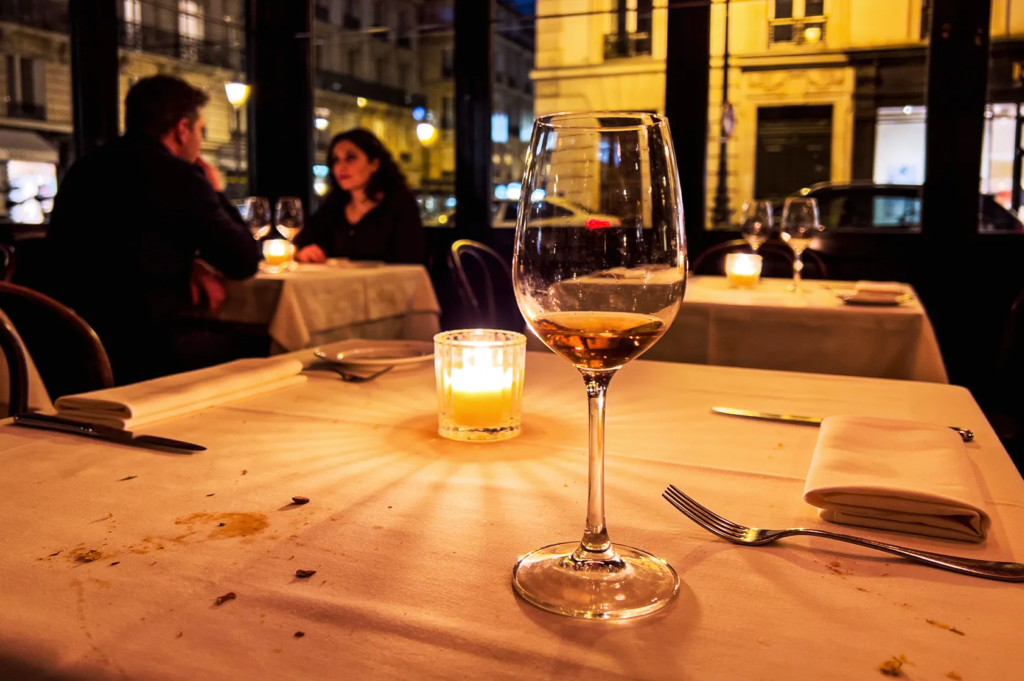
By the time we left that evening, the street outside had become quiet.
Inside, a few tables were still occupied.
Someone was finishing a glass of wine. At another table, two people were talking even though their plates had already been cleared.
For a moment, nobody seemed ready to leave.
Eventually, coats were collected and chairs moved backwards.
The evening ended in the ordinary way dinners do.
A door opened.
We stepped outside.
Much later, I forgot the order of the courses.
But I still remember that nobody looked at the time.