The chef picks up a piece of fish.
There is no announcement. No explanation of where it came from. No elaborate introduction.
Just a knife moving across the cutting board.
A few seconds later, the fish rests over a small portion of rice.
The chef places it in front of the guest.
A slight nod.
Then the next piece begins.
At a sushi counter, silence can sometimes communicate more than words.
The Language Behind the Counter
There is something fascinating about watching a sushi chef work.
Unlike a restaurant kitchen hidden behind swinging doors, an omakase counter places the preparation directly in front of you.
Every movement becomes visible.
The chef reaches for the rice.
Shapes it between the fingers.
Adjusts the fish.
Brushes on a little seasoning.
Then releases the finished piece.
Nothing appears hurried, even when the movements happen quickly.
What interests me most is not how complicated the preparation looks.
It is how little movement seems necessary.
A skilled chef knows where everything belongs.
The knife returns to the same place.
The cloth is folded.
The cutting board is wiped.
And the sequence begins again.
Why Omakase Requires Trust
The Japanese word omakase comes from the expression meaning to entrust something to another person.
In dining, it describes an experience where the guest leaves the selection of dishes to the chef.
This idea of omakase dining changes the relationship between the person preparing the food and the person eating it.
You are not choosing from a menu.
You are allowing someone else to decide what should arrive next.
That requires a different kind of attention.
The chef considers the ingredients, their condition and the order in which they should be served.
The guest watches, tastes and waits.
There is an understanding between both sides of the counter.
Neither needs to fill every moment with conversation.
The Smallest Movements Matter
At some of the best omakase counters in Singapore, the distance between chef and guest is remarkably small.
Sometimes only the width of a wooden counter separates them.
From this distance, details become difficult to ignore.
The angle of a knife.
The pressure of a fingertip.
The way rice is handled without being compressed too firmly.
A chef may adjust a piece of sushi by only a few millimetres before serving it.
To someone watching casually, the movement might seem insignificant.
But these small decisions are part of the craft.
They reveal the attention required to make something appear simple.
Silence Is Not the Absence of Hospitality
We often associate hospitality with conversation.
A warm greeting.
An explanation.
A question about whether everything is enjoyable.
But hospitality can also be expressed through restraint.
A chef notices when a guest is ready for the next piece.
A server replaces a cup of tea without interrupting.
Someone waits until a conversation ends before approaching.
The experience continues without demanding constant attention.
Of course, not every sushi counter is quiet.
Some chefs are lively, conversational and generous with stories.
Others prefer to communicate through the food.
Neither approach is necessarily better.
What matters is whether the rhythm feels natural.
The Moment Before the Next Piece
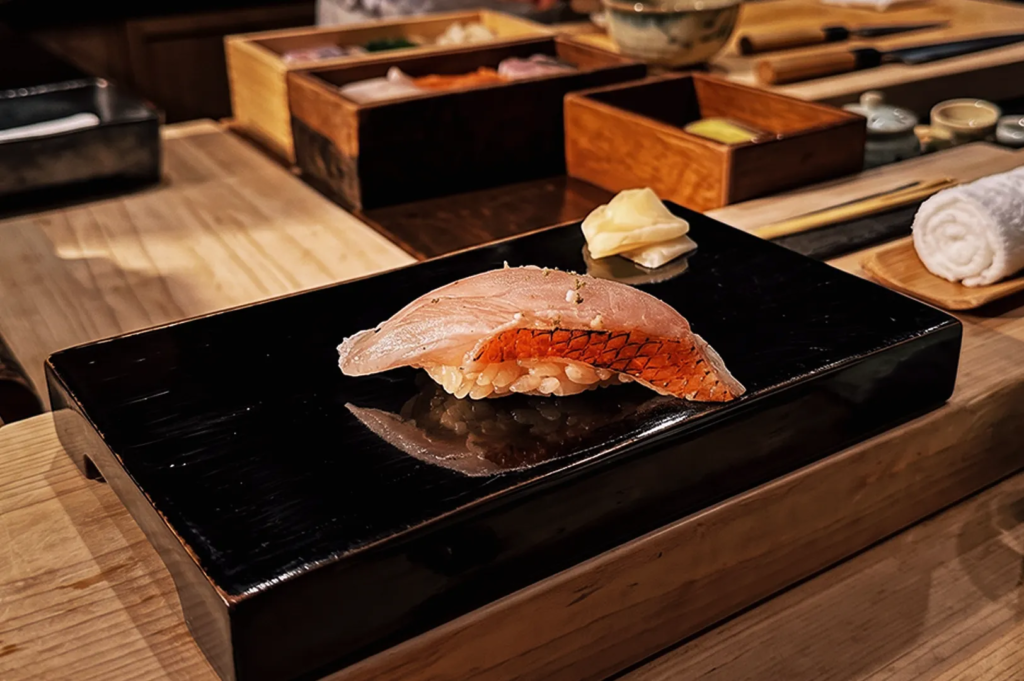
Near the end of an omakase meal, the counter often looks much as it did at the beginning.
There are no elaborate arrangements left behind.
A small plate.
A cup.
Perhaps a folded cloth beside the chef's cutting board.
The evidence of dinner disappears almost as quickly as it arrives.
One piece is prepared.
One piece is eaten.
Then another.
Eventually, the chef wipes the board.
The knife is placed down.
For a moment, nothing happens.
And somehow, that brief silence becomes one of the things I remember.